
Iver Larsen, 2009, Revised November 2026
There are several interesting translation challenges in the Christmas story in Luke 2. It is always difficult to go against tradition, especially the Christmas traditions that have outgrown and added ideas to the original text over the centuries. But it is one of my hobbies to challenge tradition, if I have good reasons to believe it needs to be challenged.
One of the issues is the “inn” in Luke 2:7. Based on Luke’s usage of the Greek word
KATALUMA and the customs of hospitality at the time in this region, there is little doubt that this was not an inn at all, but the guest room (probably upstairs) in the house of a reasonably well-to-do relative. Both Joseph and Mary were from the clan of David, and Bethlehem was David’s ancestral city. Few translations dare to change the sacred “inn”, but the revised NLT (New Living Translation) has moved in that direction.
“She gave birth to her first child, a son. She wrapped him snugly in strips of cloth and laid him in a manger, because there was no room for them in the village inn.” NLT96
“She gave birth to her first child, a son. She wrapped him snugly in strips of cloth and laid him in a manger, because there was no lodging available for them.” NLT2004
I assume they deliberately wanted to be unclear rather than saying that the guestroom was already occupied. Joseph and Mary did apparently get lodging in the downstairs room/space used for the animals in wintertime. (Since Jesus was not born in the winter, the room probably had no animals in it, the sheep being in the grazing fields. In another article I argue that Jesus was probably born on May 8th, 2 BC.) But it is also possible that NLT2004 wanted to retain the ambiguity of the original KATALUMA.
There is a textual problem in Luke 2:2. Most manuscripts, including the good quality A and C have one text. Vaticanus (B) and a few others have the other text which for some reason has been adopted by the NA and UBS text, maybe because it is the more difficult reading. Let me quote the two readings here:
1. αὕτη ἀπογραφὴ πρώτη ἐγένετο ἡγεμονεύοντος τῆς Συρίας Κυρηνίου.
hAUTH APOGRAFH PRWTH EGENETO hHGEMONEUONTOS THS SURIAS KURHNIOU
2. αὕτη ἡ ἀπογραφὴ πρώτη ἐγένετο ἡγεμονεύοντος τῆς Συρίας Κυρηνίου.
hAUTH hH APOGRAFH PRWTH EGENETO hHGEMONEUONTOSTHS SURIAS KURHNIOU NA apparatus claims that the original hand of Sinaiticus also supports 1, but this is questionable, because that original hand is clearly a mistake.
The relevant verse can be seen here:
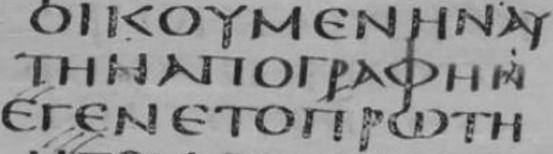
The middle line shows THN APOGRAFHN with AU in the line above it (meaning: this census). The original manuscript had AUTHN APOGRAFHN, which must be a careless copying error, since the accusative makes no sense in this context. The manuscript was corrected by rubbing out the slash between the vertical strokes of the final N in AUTHN and replacing it with a horizontal line, producing an H. The final N in APOGRAFHN was deleted. I suppose NA said it supported reading 1 because there was no H before APGRAFHN in the original hand. But when the original hand is obviously faulty, it doesn’t carry much weight.
The same manuscript (Sinaiticus) has the order ἐγένετο πρώτη rather than πρώτη ἐγένετο. That helps to show that PRWTH is to be construed with the genitive phrase, but it does not have enough support for it to be considered original.
We find the second reading in the important Alexandrian masnuscript as shown in the following print. AUTH H APOGRAFH (without spaces between the words) can be seen in the midle of the second line:

To understand the phrase αὕτη ἡ ἀπογραφὴ hAUTH hH APOGRAFH, we need to know how the demonstrative hOUTOS/hAUTH (this) works in Greek. If it precedes the head noun as in hAUTH hH APOGRAFH, it indicates emphasis and contrast, i.e. THIS census as contrasted to another census. If it follows the noun as in hH APOGRAFH hAUTH, the focus is on the head noun and the phrase is a back reference to an already mentioned census.1 So, the word order leads us to look for another census that this one is contrasted and compared to, and the obvious choice will be the famous census of AD 6.
In the following, I will assume that reading 2 is original, so the remainder deals with exegeting the Greek text in its historical context. We know that Quirinius was the governor (legate) of Syria in 6-12 AD, but there is no record that he was also governor of Syria when Jesus was born. We also know that Quirinius presided over a very famous census in AD 6 which resulted in a Jewish revolt. THIS census was so well-known that Luke only refers to it as “the census” in Acts 5:37. Indeed he uses it as a known historical reference point (in the days of the census). There is little doubt that the probably well-educated Theophilus knew about THIS census in AD 6, but had never before heard about the census the emperor ordered when Jesus was born.
EGENETO is not the same as “was” as some versions have it, but it means “happened” or “took place” as GNB (Good News Bible) has. It gives a time indication as to when THIS census took place as contrasted to another census.
PRWTH is the feminine form of PRWTOS, since it agrees with APOGRAFH. It basically means “ahead of” in terms of either time, position or status. PRWTOS is here followed by a genitive phrase. Now, in all other similar places where PRWTOS is followed by a genitive phrase in the NT it means “prior to” or “before”. I am excluding places where it refers to the first member of a class, such as the first day of the week or a leading city or person among a group of people or cities.
PRWTOS in the sense of before is not very common, but it does occur a few times in the NT: Jhn 1:15,30 ὅτι πρῶτός μου ἦν. hOTI PRWTOS MOU HN (that he existed before I did)
Jhn 15:18 γινώσκετε ὅτι ἐμὲ πρῶτον ὑμῶν μεμίσηκεν. GINWSKETE hOTI EME PRWTON hUMWN MEMISHKEN (know that it has hated me before (it hated) you)
1Tim 2:1 Παρακαλῶ οὖν πρῶτον πάντων PARAKALW OUN PRWTON PANTWN (So I urge you before everything else). This may not necessarily be time, but could be first in terms of importance.
To conclude then, I suggest that the Greek text should be understood to be saying: THIS census took place before (the one you know about when) Quirinius was governing Syria.
The exegesis is based both on the Greek text and relevance theory (RT). Why would Luke mention a “first/prior” census unless the addressee was familiar with the later and famous census? Luke is forestalling and correcting the potential connection in the mind of the addressee to the later census.
So far, I have not seen any translation go this way. I think there are two common objections. One: Oh, it is just a pious attempt to twist the text to conform with historical facts. My point is that it is not at all a twisting of the text, but the most reasonable understanding of the text in view of RT. Two: If Luke had meant prior to, he should have used PROTEROS. But that is a mistake based on Latin grammar and Classical Greek. In the NT, the concept of “prior to” is shown by PRWTOS, whereas PROTEROS means “formerly”. This mistake is reflected in the comment by Marshall: “PRWTOS has been taken as equivalent to PROTEROS with a genitive of comparison: ‘This census took place before Quirinius was governor’ (cf. Jn. 5:36; 1 Cor. 1:25; so Lagrange, 66-68; MH III, 32).” I say: PRWTOS can mean “before”, but it is not equivalent to PROTEROS in NT Greek. It
may be worthwhile quoting A.T. Robertson2 on this:
“Thus in the N. T. πρότερος an adjective occurs only once, κατὰ τὴν προτέραν ἀναστροφήν (Eph. 4:22). It is rare in the papyri (Moulton, Prol., p. 79). Elsewhere πρῶτος holds the field when only two objects or persons are in view, like πρῶτός μου (Jo. 1:15), πρῶτος and ἄλλος (20:4), etc. Cf. our ‘first story’ when only two stories are contemplated, ‘first volume,’ etc. And as an adverb πρότερον survives only ten times (cf. 2 Cor. 1:15), while πρῶτον is very common. Luke does not use πρότερος (adjective or adverb) so that πρῶτος in Ac. 1:1 with λόγος does not imply τρίτος. Moulton finds πρότερος only once in the Grenfell-Hunt volumes of papyri so that this dual form vanishes before the superlative πρῶτος. Winer (Winer-Thayer, p. 244) sees this matter rightly and calls it a Latin point of view to insist on “former” and “latter” in Greek, a thing that the ancients did not do. The LXX shows πρῶτος displacing πρότερος (Thackeray, Gr., p. 183). So in English we say first story of a house with only two, first edition of a book which had only two, etc. It is almost an affectation in Greek and English, however good Latin it may be, to insist on πρότερος.”
I am surprised that BAGD and BDAG put Luke 2:2 under sense 1b in the entry for πρῶτός, when it seems to fit better under 1a, where they say:
“Used w. a gen. of comparison (Ocelus Luc. 3 ἐκεῖνο πρῶτον τοῦ παντός ἐστιν=prior to the All ….) πρῶτός μου ἦν he was earlier than I = before me J 1:15, 30 (PGM 13, 543 σοῦ πρῶτός εἰμι…). So perh. also ἐμὲ πρῶτον ὑμῶν μεμίσηκεν 15:18.”3
Notes
- See the article on Word order in Greek. ↩
- See XIII. The Comparative Adjective (συγκριτικὸν ὄνομα). (a) CONTRAST OR DUALITY (p. 659) ↩
- Arndt, W., Danker, F. W., & Bauer, W. (2000). A Greek-English lexicon of the New Testament and other early Christian literature (3rd ed.) (893). Chicago: University of Chicago Press. ↩